

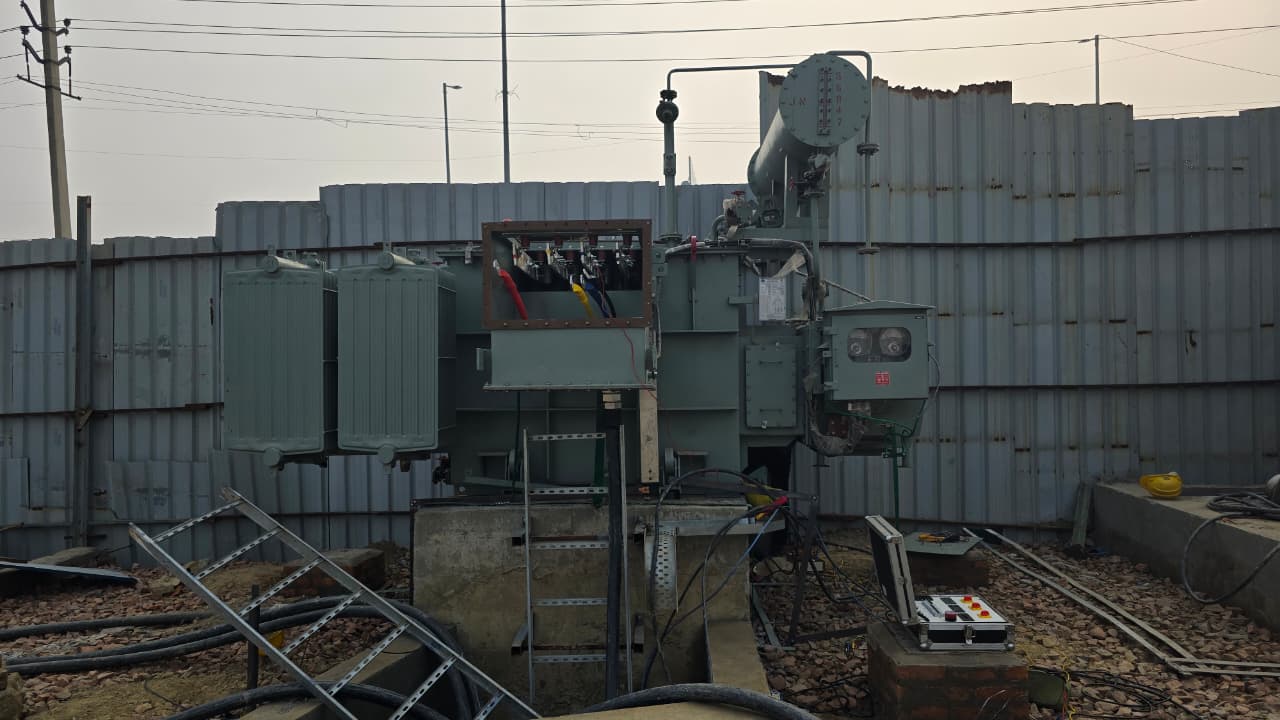
Bringing Transformers Back to Life!!
We at AKG provide you with the best possible solutions for your transformer which is beneficial for our clients. We tend to comply all the compliances & safety procedures beneficial for both ends.
Let us first understand why we require transformer testing.
Transformers need testing to ensure they are safe, reliable, efficient, and operating correctly before and during service. In electrical power systems, a faulty transformer can cause outages, equipment damage, fire hazards, and major financial losses.
Here are the main reasons transformer testing is important:
1. Verify Manufacturing Quality
After a transformer is built, tests confirm that:
- Windings are connected correctly
- Insulation is adequate
- Core and coils are properly assembled
- Voltage ratios meet design specifications
This ensures the transformer matches its rated performance.
2. Ensure Electrical Safety
Transformers operate at high voltages. Testing helps detect:
- Insulation breakdown
- Short circuits
- Ground faults
- Moisture contamination
These issues can lead to electric shocks, fires, or catastrophic failures.
3. Prevent Unexpected Failures
Over time, transformers age due to:
- Heat
- Overloading
- Moisture
- Oxidation
- Mechanical stress
Regular testing identifies early warning signs before a major breakdown occurs.
4. Improve Reliability of Power Supply
Utilities and industries depend on uninterrupted power. Testing helps maintain:
- Stable voltage
- Efficient operation
- Continuous service
A failed transformer can shut down factories, hospitals, or entire neighborhoods.
5. Detect Internal Damage
Events like short circuits or lightning strikes may damage internal parts. Tests can reveal:
- Winding deformation
- Core faults
- Insulation deterioration
- Loose connections
Many of these problems are not visible externally.
6. Maintain Efficiency
Testing checks whether the transformer is operating efficiently by measuring:
- Copper losses
- Core losses
- Temperature rise
- Oil quality
Poor efficiency wastes energy and increases operating costs.
7. Meet Standards and Regulations
Transformers must comply with standards such as:
- IEC
- IEEE
- IS standards
Testing certifies that the transformer satisfies these requirements.
Common Transformer Tests
Some widely used tests include:
- Insulation Resistance (IR) Test
- Transformer Turns Ratio (TTR) Test
- Winding Resistance Test
- Oil Breakdown Voltage Test
- Vector Group Test
- Sweep Frequency Response Analysis (SFRA)
- Temperature Rise Test
Each test checks a different aspect of transformer health and performance.
